
OK, so how many of you
are thinking about your fifth wheel right now? Probably not many, right? Well
like everything else on your truck, it needs maintenance. Which means you
also probably need a checklist to do it right. Everyone loves a checklist,
and we've got you covered.
1)
First, you're going to need to clean the gunk off that fifth wheel. Some
folks go so far as to steam clean it; others simply scrape and clean it with
a brush and solvent. You should know that it is recommended that you steam
clean not only the top plate, but the jaws and legs, as well.
2)
Next you're going to inspect the upper area and edges for any damage. This
can simply be wear and tear, or something more excessive - like missing parts
or cracks. You're going to need to find a straight edge, too, because you've
got to check the flatness of the fifth wheel. Cracks are obviously bad, as
well. Finding them can be tricky if you're not steam cleaning the fifth
wheel, but if you check underneath it, you can see any grease making its way
through a crack.
3)
Look at the jaw area. Is there any damage, or excessive wear? You should have
a test pin from your manufacturer. You're going to use this to engage the
locking mechanism. Check the release handle, as well. This needs to be
straight and secure. Look for any missing parts. Adjust the locking
mechanism.
4)
You'll want to examine the bracket pins and legs for any type of damage
(slack, wear or cracks).
5)
Check those Zerks. Obviously, grease fittings should be intact and unclogged.
6)
This is the point where you're going to need the square. Review the flatness
of the bolster plate, as well as the kingpin. You're looking for any
deformities in either one. No one likes it, but when you find damage in
either one, you're going to need to replace it.
7)
Check your kingpin for wear, as well. You're going to need a kingpin gauge
for this.
8)
Now that you've made it through the inspection, hopefully without needing to
replace anything, it's time to look at the necessary maintenance. First,
lubricate the jaw and locking mechanism. You're going to do this with a
silicone based spray lube, or some other light oil.
9)
Let's give the zerks something to do now. You're going to use the grease gun
for the bracket pin zerks to lube the surfaces above the pin.
10) Now for
the top plate. While many drivers and mechanics apply high quality grease all
over the fifth wheel, you only need to grease the rear part, as the action of
connecting a trailer will apply the grease to the rest of the fifth wheel.
Note: Not all of these
steps apply if you have a fifth wheel with a Teflon disc. The disc is the
lubricant.
|
Fifth Wheel Maintenance

Height Sticks and GPS
You’ve seen the videos and pictures on the web. You know it happens – just not to you. And this is exactly how it starts.
Every day we see a video of a truck carrying a large load hitting a bridge, underpass or some other object of civil engineering. In fact, over 60 percent of states say that over-height accidents are considered a significant problem. The problem is so bad in the empire state that New York is installing “Over-Height Vehicle Detection Systems” to alleviate it. (You have to wait for troopers to guide you to another route if you’re over height, and that can’t be an enjoyable process.)
So, how do these strikes happen so frequently when we all know to measure twice and plan the route accordingly? It’s all about safety culture and technology. Just like larger companies, small operations need to instill their safety processes and procedures – especially if they’re currently not in place.
It’s all about knowing everything about the load you’re carrying. Just as you know when you’re overweight, you also need to know when you’re over height. The only way to know that is to measure for it. If you don’t have a height stick; get one. Today.
 Now that you know the height of the load, it’s time to plan the route to the destination. In doing so, there’s one piece of equipment you want to avoid; a noncommercial GPS system. If you’re relying on a GPS system, make sure it’s one used for the trucking industry. Consumer GPS doesn’t show low bridges or hazmat routing. They don’t need to. You, however, need to know.
Most commercial systems available will adjust your route according to the measurements, axle weights and whether you’re carrying haz-mat. Even the government wants to make sure truckers are aware of the benefits of commercial GPS. FMCSA recently published a visor insert to make sure everyone knows about it when purchasing a truck.
These are just a couple of ways to improve the safety of your organization. There are many more coming your way.
East Coast Truck and Trailer Sales 877.814.9468 Parts.ECTTS.Com

East Coast Truck and Trailer Sales 877.814.9468 Parts.ECTTS.Com
How Are Your Driving Skills At 100+ Miles Per Hour?
It’s cold and absurdly early on this Las Vegas morning, but 30+ people couldn’t be happier. Not just because it’s Vegas, but because East Coast Truck and Trailer Sales is hosting their Richard Petty Driving Experience again. If you’ve never been, the Richard Petty Driving Experience is a thrill ride you control - starting at 100+ mph!
Every year, the folks at ECTTS ask a number of their friends and customers to come out for the driving experience of a lifetime. This is a chance to drive a car as fast as you can – without any fear whatsoever of a ticket. In fact, the faster the better! So much so, we keep track of the stats.

The day starts with a facility overview of Las Vegas Motor Speedway. There’s roughly 1,500 acres to the Las Vegas Motor Speedway, consisting of over 10 tracks. There’s the 1/2 mile World of Outlaws dirt track, the quarter mile NHRA drag racing facility known as “The Strip” and the 3/8 mile “Bullring”, which is the home track of NASCAR superstars Kurt and Kyle Busch as well as Brendan Gaughan – just to name a few.
But before you’re allowed to put a 600+ HP car through its paces, you have to go through safety and instruction and in-car/on-track training. This isn’t just a formality if you’re driving these beasts, this is absolutely necessary. You need to know how the brute you’re going to be doing your best to control will handle in a curve, or “out of the groove.” You’ll hear from the instructors/drivers just what you’re going to feel, and at what speed. They know these finely-tuned monsters; they drive them every day.
Now it’s your turn at the wheel; right? Well, first you’ll be taken on a ride-along to get a feel for the track, and experience the car “at speed.” You get to see what it feels like to take a curve as fast as possible without slamming into a wall. Then you get to feel the acceleration push you into the seat – when you’re already doing over 100 mph! You’ll amusedly remember when you used to get a thrill punching the accelerator on the family sedan to pass a sluggish truck. And this is just the instructional phase.

“OK, this should be easy”, you convince yourself, as you climb into the driver’s seat. What you don’t understand – until you try it for yourself, is that the instructor made it look easy because of their experience. For you, getting this race car up to something even close to 130 mph is taking some work. Not that the car won’t do it, but because you’re having a tough time getting up the nerve to go much faster. Way too soon, this thrill ride is over, but you get a chance to see just how much bravado you had. After it’s all over, you get a packet that includes a time sheet with a breakdown of every lap you drove on the track.
Finally, at the end of the day, ECTTS holds a dinner for their customers, friends, and employees. The food’s good, but the stories and laughter are even better. Let’s face it, half the fun of this type of outing is comparing how you did with the rest of the guests. The only problem lies with the inevitable request to see the hard copy of your exploits, to confirm those “enhanced” tales of the track. Chris Kelly, one of our customers, posted this year’s top speed at 141 mph! We’ll keep the lowest speed to ourselves, so as to keep the embarrassment to a minimum. As we said earlier, we do keep track of the stats.
Keep Your Diesel Particulate Filter From Dying an Early Death
Keep Your Diesel Particulate Filter From Dying an Early Death.
You’re 25 miles out of the truck stop; settling into the long haul, and then the regen warning light comes on - again!You know you just did a parked regeneration to clear the diesel particulate filter yesterday, and you’ve been driving this rig at speed today, so shouldn’t the filter be clean? Well, probably not. Here’s why:
• Unless you’re running a disposable filter system, which are a must in the mining industry and some off-road equipment, the DPF is probably still clogged, but not with soot. The DPF works by trapping soot and other particulates in a network of cells before releasing the smaller gasses through the pores in the filter structure (usually cordierite or silicon carbide). The DPF, like any filter, eventually gets clogged with this material. Unlike other filters, this filter can usually be easily cleared – either while you’re on the road, or parked, by simply heating the filter to the point where the soot burns off to become gasses that pass through the filter. The problem arises when other particles besides soot become trapped in the filter. While hydrocarbons burn, metals and other contaminates from oils in the exhaust don’t burn off at the temperatures used for regeneration, so you end up with a clogged filter – even though you’ve just done yet another regen.
• Why does this happen? The heat from the regen can cause the metal particles to simply fuse into solid masses (sintering), and like the metals, the non-soot particles aren’t going to burn off either. In some cases the filter itself is damaged by the heat being created by the regen. As regeneration happens at temperatures around 850 to 1100 degrees Fahrenheit, and damage happens to some filters at 1200 degrees, the range between clean and damaged can be fairly narrow.
• Sometimes known as de-ashing, the filter cleaning process begins with an inspection, and then moves through the steps of testing, pneumatic cleaning, thermal regeneration (about 12 hours) and a final air flow test. At the end of the cleaning the air flow test will tell whether it passes for continued use, or needs to be replaced. How often you regen, vs. letting your filter compact with particulates and ash, can greatly affect the usable life of your filter. Similarly, having your filter removed and cleaned regularly increases its lifetime, so this step should be an important part of your regular maintenance schedule.
• Finally, this is not a do-it-yourself job you want to tackle. Unless you have the proper equipment, and knowledge, it will just end up being a very expensive lesson in what not to do yourself. Dealerships and service centers nationwide offer DPF cleaning services; take advantage of it on a regular basis to keep your filter and engine operating at its best.

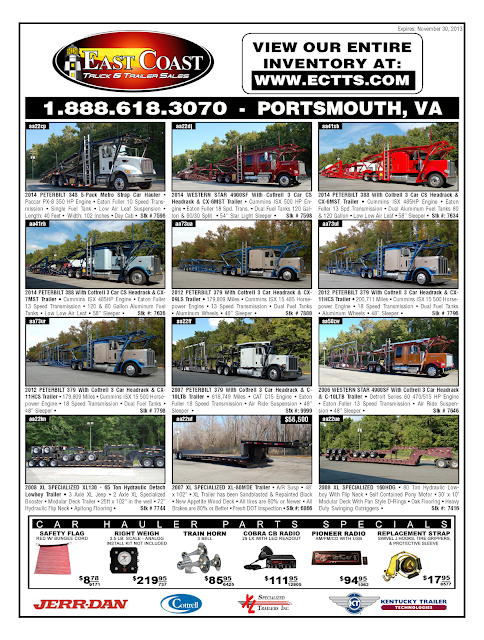
East Coast Truck and Trailer Sales Car Hauler and Equipment Specials

East Coast Truck and Trailer Sales Equipment Specials. Click picture above for parts specials. Click picture below for car hauler deals.
Subscribe to:
Posts (Atom)